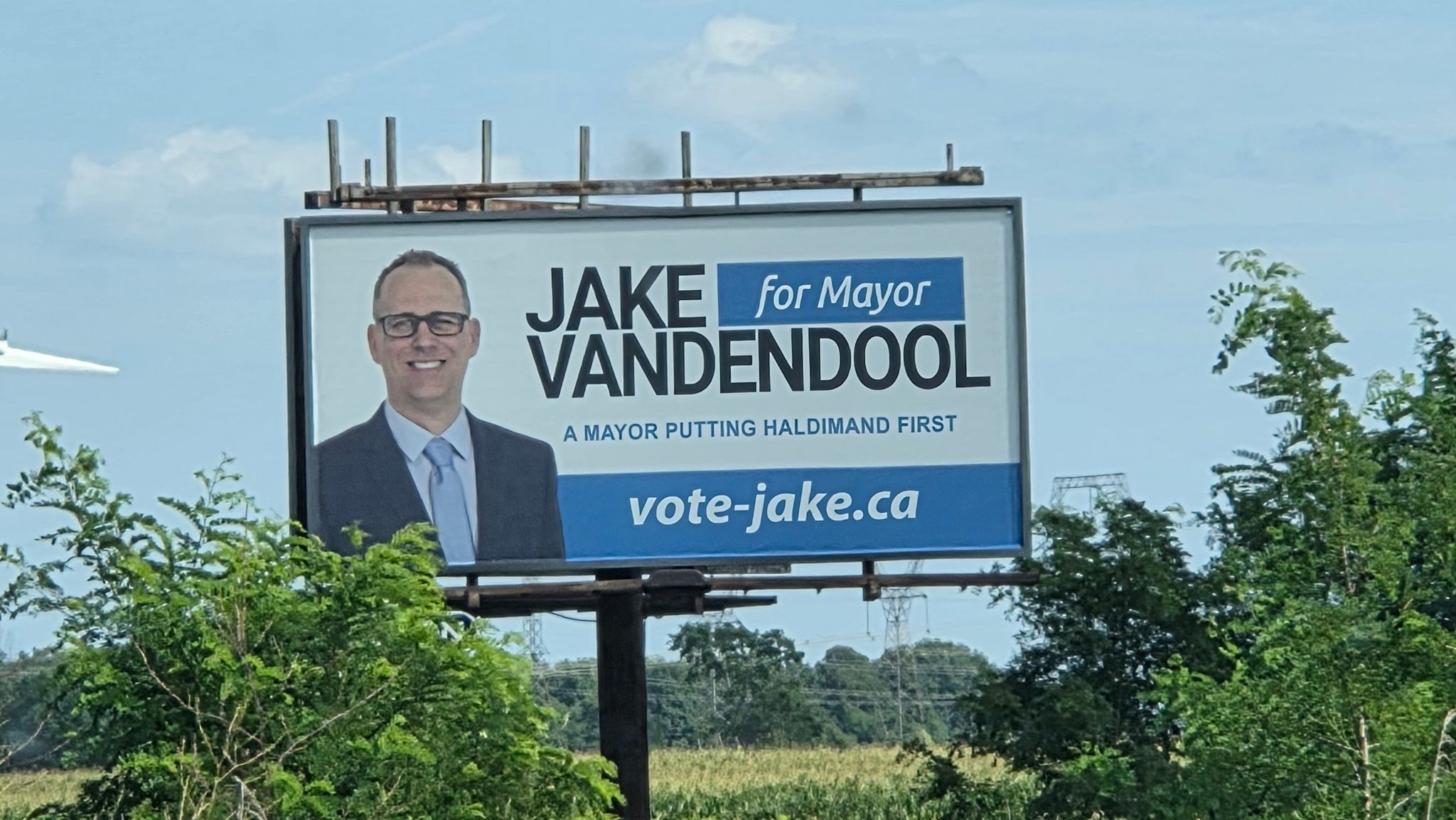
Over the past few days, there has been considerable discussion on social media about my campaign billboard in Jarvis, including claims that it is somehow illegal.
I also want to acknowledge that this has become an unintended and unexpected distraction from the issues this campaign should really be about. I certainly did not expect that purchasing advertising space in accordance with the provisions of the Municipal Elections Act on an existing commercial billboard would generate this much attention.
Unfortunately, some of that attention appears to have resulted from what I believe was a highly inappropriate knee-jerk response from Haldimand County Bylaw.
The first communication I received from Bylaw reached an immediate conclusion that the billboard violated the County’s Election Sign rules and informally requested that it be removed.
The reality today is much different than some of the discussion online would suggest.
Although Bylaw has contacted me regarding the billboard, I have not received a formal written order requiring its removal. More importantly, the County has still not provided a substantive answer to the most basic question I have asked from the beginning:
How does a permanent commercial billboard cease being a billboard and become a temporary Election Sign?
That question matters because of how Haldimand County wrote its own bylaw.
Haldimand’s Sign Bylaw contains definitions for different types of signs.
A Billboard Sign is essentially an outdoor sign operated by a person or business that sells or rents advertising space to clients.
That is exactly what this is.
The billboard is a permanent structure. It has a permanent foundation. A commercial billboard company operates it and rents advertising space on it. The structure existed before my advertisement was installed and will remain long after my advertisement is removed.
The County’s definition of an Election Sign, however, begins with something very important.
An Election Sign is defined as a temporary sign advertising a political party, candidate or registered third-party advertiser.
The County then separately defines what a Temporary Sign is. Importantly, the bylaw defines a Temporary Sign as a sign that does not have a foundation.
This creates a very simple test.
The billboard at issue is a permanent structure with a permanent foundation. Before the County can classify it as an Election Sign, it first has to explain how that structure satisfies its own definition of a Temporary Sign when the bylaw expressly distinguishes temporary signs from signs that have a foundation.
So far, that has not happened.
Instead, Bylaw has relied on interpretations such as the Election Sign definition being the “best fit,” looking at the “purpose” of the advertisement, and suggesting that where provisions overlap, the more restrictive provision should apply.
Those interpretations do not answer the threshold question: How does this permanent structure satisfy the bylaw’s definition of a Temporary Sign in the first place?
The bylaw separately defines Billboard Signs, Permanent Signs, Temporary Signs and Election Signs. An Election Sign is expressly defined as a Temporary Sign. Before any Election Sign restrictions can apply, that requirement has to be satisfied.
Changing the advertisement on a permanent billboard does not change the physical sign.
There is an even more obvious example on this particular billboard. The structure has two advertising faces mounted on the same permanent support structure. The opposite face displays ordinary commercial advertising and unquestionably remains a Billboard Sign, while under the County’s interpretation, my side of that exact same structure somehow takes on an entirely different identity as a Temporary Election Sign simply because of the message being displayed. Both faces share the same permanent foundation, support structure, location, height and physical characteristics. How can one face of the same sign be a permanent commercial billboard while the other face, using the exact same structure, is suddenly considered a Temporary Sign?
I have asked the County several times to explain where that authority comes from.
I am still waiting for that answer.
There is a second issue that may ultimately be even more important.
In July 2025, the Ontario Superior Court released its decision in Armstrong v. Township of Russell, a case dealing directly with municipal restrictions on election signs.
Russell Township restricted when municipal election signs could be displayed and imposed additional restrictions on where they could be placed. The Court found that those restrictions violated freedom of expression under section 2(b) of the Canadian Charter of Rights and Freedoms and that the municipality had failed to justify them under section 1.
The Court said a municipality cannot simply point to similar rules elsewhere to justify restrictions on political expression. It must be able to demonstrate that the restrictions are justified and impair Charter-protected expression as little as reasonably possible.
Russell argued that its restrictions were needed for reasons including safety and aesthetics. The Court found there was no evidence demonstrating special safety or aesthetic problems caused by election signs and questioned why election signs were being treated more restrictively than other types of signs without evidence supporting that distinction.
That has a very direct connection to the Jarvis billboard.
The structure, height, dimensions, foundation, relationship to the roadway and sightlines remain unchanged whether the billboard displays a commercial advertisement or a political one. The only difference is the message displayed on it.
If the billboard can safely display a commercial advertisement, there is no obvious safety or aesthetic reason why the exact same structure should suddenly become unsafe or unacceptable when the advertisement says “Jake Vandendool for Mayor.”
Yet under the County’s current interpretation, commercial advertising can use the billboard while political advertising is subjected to entirely different restrictions solely because of its content.
That is precisely the type of distinction that raises a Charter problem.
Political expression sits at the heart of the freedom of expression protected by the Charter. The Court in Armstrong recognized that political expression during an election campaign deserves particularly strong protection.
Haldimand therefore cannot simply impose more restrictive rules because an advertisement is political. It must be able to justify why those additional restrictions are necessary.
Since the Armstrong decision was released, municipalities across Ontario have been reviewing and changing their election-sign bylaws in advance of the 2026 municipal election.
City of Guelph staff specifically recommended changes to its Election Sign Bylaw following Armstrong to ensure its rules comply with the Charter.
The City of Owen Sound reviewed its own 30-day election-sign restriction and recommended allowing campaign signs immediately following Certification Day. Its staff report specifically cited Armstrong and the Court’s finding that the time restriction was an unjustified infringement of freedom of expression.
Other Ontario municipalities have undertaken similar reviews and amendments.
Haldimand’s Sign Bylaw predates the Armstrong decision by many years. Its election-sign provisions include a 45-day limit on when municipal election signs may appear, along with special size, height and other restrictions.
Based on the reasoning in Armstrong, I believe there is now a very serious question about whether those provisions can be constitutionally enforced in their present form.
That is something the County needs to address, regardless of whose name happens to be on this billboard.
At this point, the ball is in the County’s court.
Bylaw has contacted me, but I have received no formal written order requiring the billboard to be removed.
My position remains clear: this is a Billboard Sign, not an Election Sign. It is a permanent commercial advertising structure with a permanent foundation. Nothing about changing the advertisement displayed on one face of that structure turns it into a Temporary Sign.
I have asked the County to explain how its interpretation works under the actual wording of the bylaw. So far, I have not received a substantive answer.
Even if the County were able to establish that this is an Election Sign, applying the County’s more restrictive Election Sign provisions would still raise the separate Charter issue identified in Armstrong. Subjecting political advertising to greater restrictions than otherwise identical commercial advertising would, in my view, be fatally flawed by the Charter infringement identified in Armstrong.
I have asked the County to address both issues and will await its response.
Rest assured, I have always played by the rules and will continue to do so. I would never compromise my values or ethics for a billboard, an election or political advantage.
I will also always stand up for what I believe is right. The freedoms protected by our Charter, including freedom of political expression, should never be taken for granted. Generations before us fought hard to protect those freedoms, and I believe we have a responsibility to respect and defend them when they are challenged.